

Two weeks ago I handed back the corporate laptop.
Thirty years of corporate work — building and leading different risk analytics teams at various institutions — and then, on a Friday, no mandate is attached anymore. No team. No model committee. No executive deck to prepare for.
I am a free agent now; I will continue to build and lead. This year changed my view of the work itself with the emergence of AI agents / teammates. I will not repeat all the prophecies on how AI will impact our jobs. But I will learn to leverage the new “teammates” to make the most of them.
When you build things in 2026, you discover very quickly that the part everyone still worries about — writing the code — is no longer where the difficulty lives. It is something else: the agency to choose a meaningful problem to solve, the decision to pivot when it did not work out, and the judgment on what does “good enough” mean. These are the skills that our younger teammates will accelerate on.
🚂 What the last 15 years trained us to believe
If you have worked in business analytics since roughly 2010, the shape of a project is burned into you:
Scope it with the business, badly, because nobody knows what they want yet.
Wait (and beg) for data access.
Write the data engineering codes
Write the model training and inference codes
Discover the business question changed
Ship something with no user interface, and let the insights die in a slide deck. Or beg again to IT to whip up an “expensive” dashboard.
Every step needed a human writing code. So we hired for that, promoted for that, and we planned meticulously for whole build. The build was so expensive that we front-loaded enormous ceremony (meetings and committees) to avoid building the wrong thing.
The build is no longer the expensive part. The ceremony is.
🤖 What actually changed
To test the coding agent capabilities, I rebuilt an entire small-business lending analytics platform on my own. Synthetic portfolio, credit scorecard, adjudication, risk-based pricing, early warning, line management, a portal to tie it together, and a documentation pack a validator could read.
Four days. About $150 in tokens. No team.
I did not write most of that code. I worked with Claude Code as a partner — I directed, it built, I reviewed, it revised. My corporate years did not become worthless; they became the judgment to proceed or not. The agent could produce a scorecard in an afternoon. It could not tell me whether the scorecard deserved to be used.
The leverage moved. It used to sit in the model. It now sits in the application and workflow — what you decide to build, and what you put in front of the person who has to act on it.
Here is the evidence that convinced me, from that build:
The scorecard scored AUC 0.8176. The LightGBM challenger scored 0.8096. The simple, interpretable, regulator-friendly model beat the fancy one.
The biggest finding in the entire platform — $1.28B of mis-priced exposure — came from arithmetic on top of the score. Not a better model. A pricing engine using basic accounting ratios to call for actions.
Fifteen years of instinct says: to find more value, build a better model or a strategy. That instinct is now more wrong than it is right. The value comes from how to use these tools.
🏋 The three tasteful decisions the human still owns
This is what I ended up learning from the four-day build.
1. What to build at all.
An agent will happily build anything you name. That is the present danger. It removes the natural friction that used to stop bad ideas — when a build cost six weeks, somebody asked why. When it costs an afternoon, nobody asks. You have to supply that question yourself now.
2. How the end user meets the model.
A model nobody can act on is a hobby. The unglamorous truth of that four-day build is that the interface — the portal, the reason codes, the watchlist with named triggers instead of vibes — is what made the analytics usable. Agents are startlingly good at building interfaces, which means for the first time the modeller can own the whole path from data to decision. Most of us have never had that, and are not yet in the habit of using it.
3. Not overcomplicating.
The hardest discipline of the lot. When building is cheap, the temptation is to build more: more features, more models, more dashboards. Restraint used to be enforced by budget. Now it has to be a choice. The scorecard beating LightGBM is not a cute anecdote — it is the whole argument for simplicity, written in a metric.
The why, interface, and choice remain ours - the team human.
📊 Credit Analytics with AI: five sessions workshop
I will organize a 5-session workshop in September 2026. Each session is 90 minutes and ends at a tagged, verified checkpoint. One command always tells you where you stand:
python verify.py
✅ Stage 5 verified — you are here, and it works.
If you get lost, you are never more than one command from a working state. Miss a session entirely and it costs you nothing — every stage ships the previous stage’s outputs.
Session 1 — Your portfolio. You build a synthetic SME portfolio and audit it. You leave with 12,000 businesses that never existed — and the leakage instinct.
Session 2 — Your credit score. You build a WoE credit scorecard, trained and gated. You leave with a model that passes a hard gate, or honestly doesn’t ship.
Session 3 — Decisions. You build adjudication and risk-based pricing on that score. You leave with approve/decline plus reason codes, and the mispricing find.
Session 4 — Your watchlist. You build early warning and proactive line increases, behind one portal. You leave with a watchlist of named triggers, and growth inside risk appetite.
Session 5 — Governance. You build the model documentation pack. You leave with something you could hand to a validator — and defend.
🔗 Watch it before you decide
I would rather you check out the materials before you decide. Watch the 60-second video at the top of this blog.
Everything is public. The code, the slides, the lab sheets, the prompt cards, the walkthrough video:
→github.com/aayancheng/banking-analytics-workshop
There is a green “Open in GitHub Codespaces” badge at the top. One click, nothing to install, and about two minutes later your browser is running the finished platform. If that does not interest you, the workshop will not either — and you will have lost two minutes instead of five evenings.
The first cohort is free
I am running the first round as a free pilot. I would love to have interested parties telling me what may not work before asking for refund.
Session 1:
🇨🇦 Thursday, September 10 · 8:00–9:30 pm EDT (Toronto)
🇭🇰 Friday, September 11 · 8:00–9:30 am HKT (Hong Kong)
Come to the first 90 minutes. Build a portfolio, break the leakage rule, see if you like how I teach. Decide about the rest after. Every session is recorded in case you missed the time.
❓ Frequently Asked Questions
Do I need to be a strong coder?
No. You need to be comfortable reading code and running a command. On the agent track you are the reviewer — the skill being trained is judgment, not typing.
Do I need to pay for Claude or Codex?
It is a nice-to-have if you want to test the prompts and agentic workflow. Every lab has a manual track that reaches the identical checkpoint without the AI agent.
Is this credit risk only?
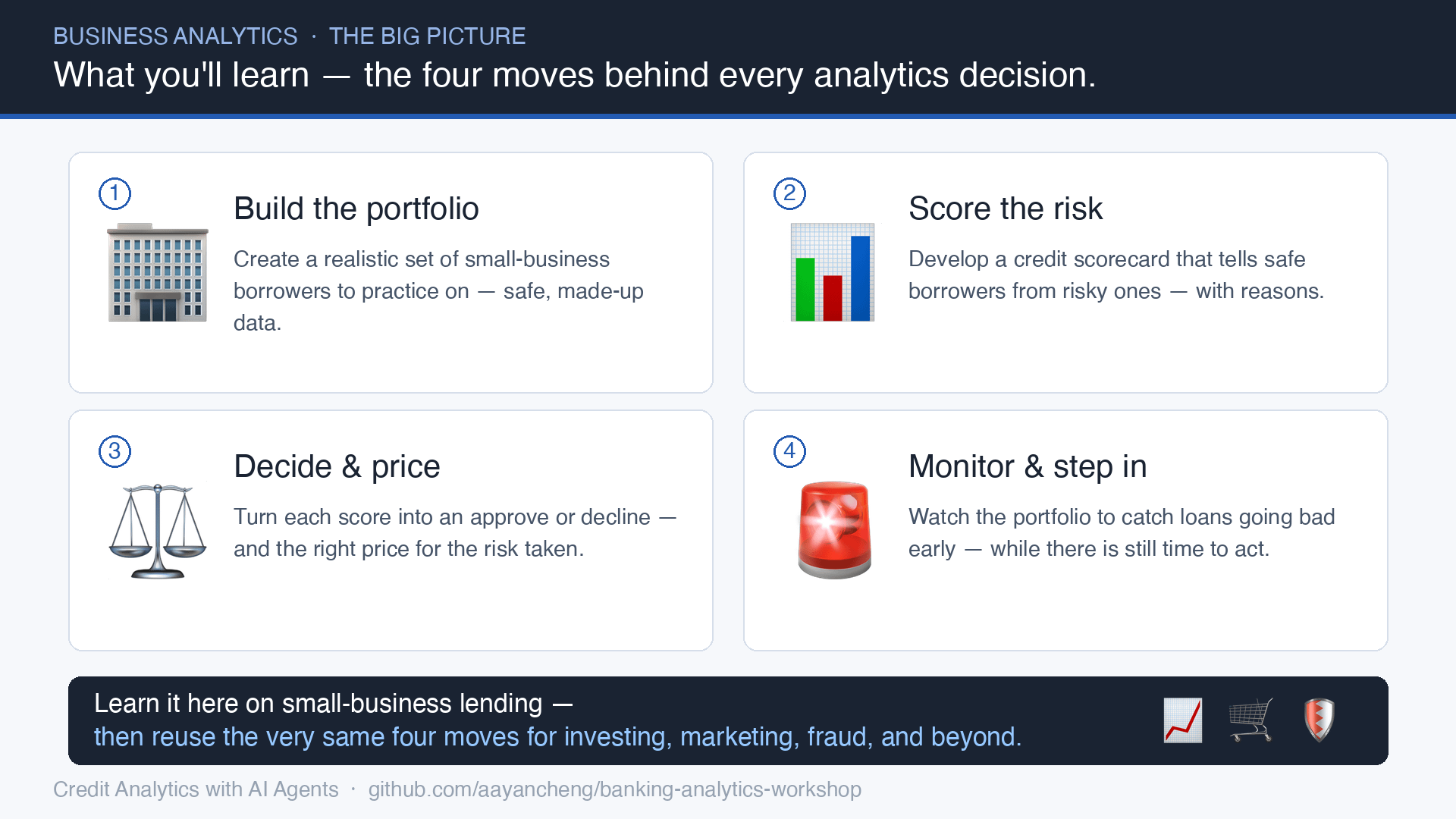
The worked example is small-business lending, because that is where I have 15 years of scar tissue. The four moves — build the portfolio, score the risk, decide and price, monitor and step in — are the same in marketing, fraud, insurance, and investing. Learn once; reuse them anywhere.
Will it be recorded?
Yes. Every session is recorded and shared, so you can catch up if you miss one — or watch later if the time zone does not work for you.
What do I walk away with?
A public repository of your own work, and a documentation pack you could show to the next recruiter. Not a certificate.
📌 The takeaway
This is not a post about a finished analytics product. The platform in that repo is a teaching artifact, and I will happily tell you it is not production grade.
It is a post about how the building happens now — you and an agent, moving fast enough that your taste becomes the binding constraint. For thirty years my judgment was throttled by how long things took to build. That throttle is gone. I am still adjusting to it, and I suspect most of us are.
The five sessions are simply the fastest way I know to hand someone that experience: from zero to a working product, with the gates on, in a domain where being wrong actually matters.
Bring your judgment. The agent will bring the codes.
Yan writes about AI and risk analytics as a free agent. Thirty years in bank risk and investment analytics; now an independent practitioner and educator in Toronto.